Dear KAT6 community,
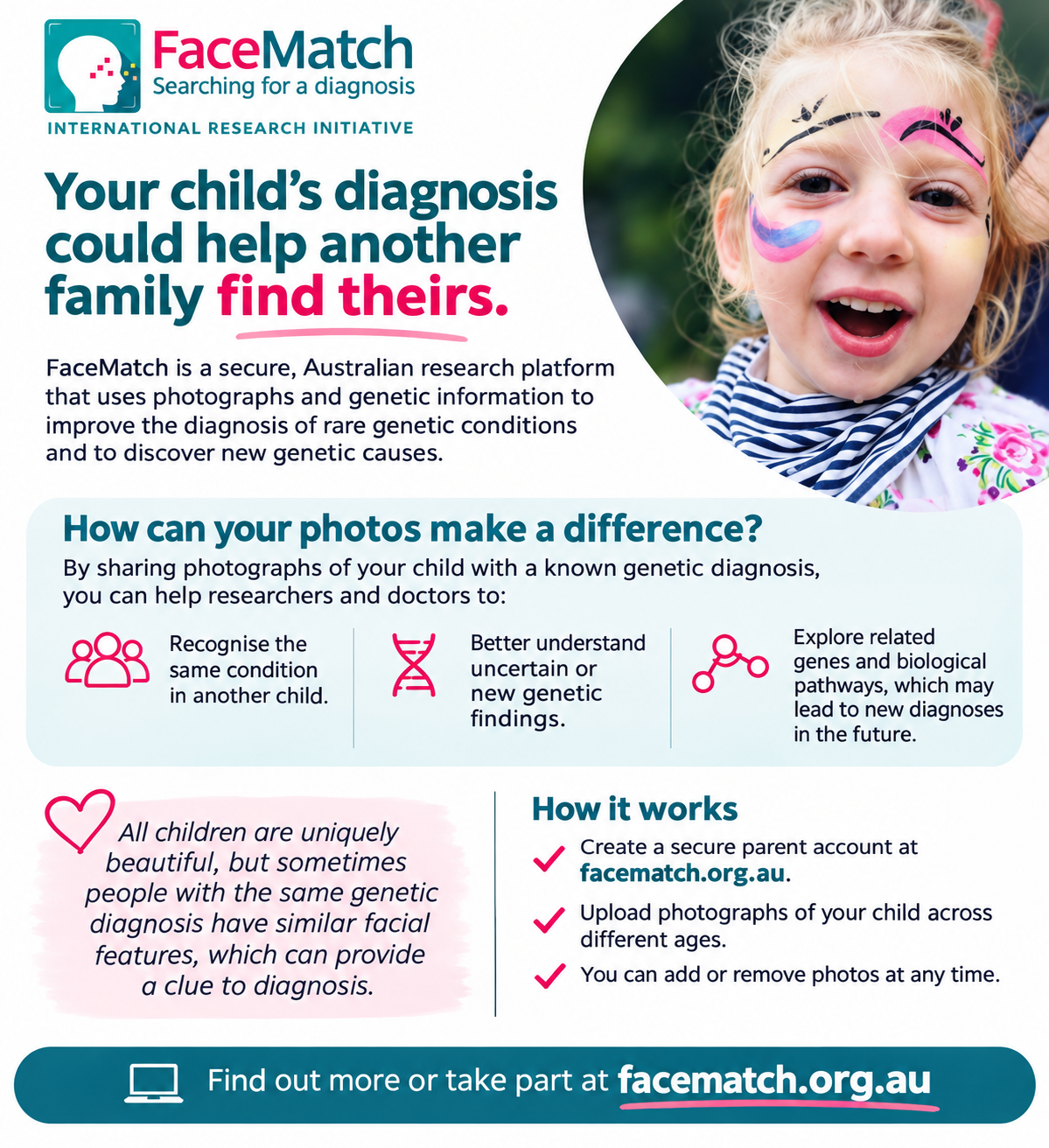
I am a clinical geneticist and Professor at the University of Newcastle, Australia, where I lead the FaceMatch research project. I am reaching out to invite families of children and adults with KAT6A and KAT6B-related disorders, including Say–Barber–Biesecker–Young–Simpson syndrome and genitopatellar syndrome, to participate in our research.
Our aim is to explore whether artificial intelligence (AI) facial matching can help improve the diagnosis of children with rare genetic conditions and intellectual disability.
Around 70% of children with intellectual disability remain without a diagnosis following exome sequencing, and there are an estimated 2,000 developmental genes still to be discovered and studied.
There are several ways facial matching may help:
- Helping interpret uncertain genetic results. Sometimes genetic testing identifies a change in a gene such as KAT6A or KAT6B, but doctors are unsure whether it explains a child’s difficulties. Facial similarity to individuals with a confirmed diagnosis may provide additional evidence to investigate.
- Helping discover new genes. An undiagnosed child may resemble someone with KAT6A or KAT6B-related disorders without having a disease-causing variant in KAT6A or KAT6B. This could encourage researchers to investigate other genes involved in similar biological pathways.
- Recognising patterns across different ages. Children’s facial features change as they grow. Comparing photographs taken at different ages may reveal similarities that would otherwise be missed.
The FaceMatch platform has been specifically developed for research at the University of Newcastle. It allows parents to provide informed consent online, enter information about their child’s genetic diagnosis and contribute photographs taken at different ages.
Our platform uses secure, encrypted data management. Parents retain control over their contributions and can add or remove photographs at any stage.
You can learn more about the project here:
Warm regards,
Professor Tracy Dudding-Byth AM
Clinical Geneticist
University of Newcastle, Australia
FaceMatch Research Project